
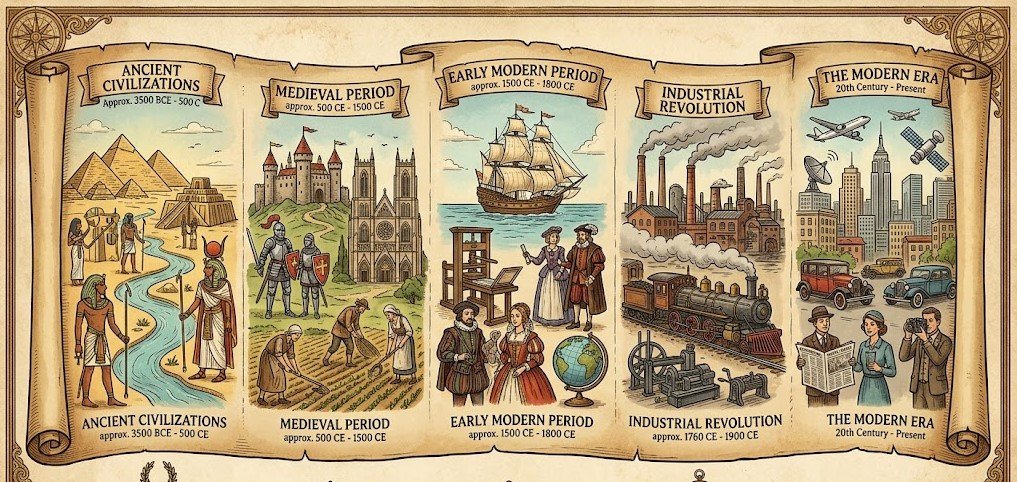
The historical time periods begin with the Prehistoric Era, which represents the earliest phase of human existence before written records were developed. During this time, early humans relied on hunting, gathering, and simple stone tools to survive. This period is extremely important because it shows how human life gradually evolved from primitive survival methods to more organized societies.
The Prehistoric Era is divided into stages such as the Stone Age, Bronze Age, and Iron Age, each marking major technological advancements. As humans learned to control fire, develop tools, and form early communities, the foundation of civilization was slowly built. The historical time periods concept starts here because it marks the beginning of human progress and adaptation to the environment.
Ancient Civilization Period
The Ancient Civilization Period is one of the most significant historical time periods, where early societies like Mesopotamia, Egypt, China, and the Indus Valley emerged. This era introduced writing systems, laws, organized governments, and monumental architecture such as pyramids and temples. These developments shaped the foundation of modern civilization.
This period also saw the rise of philosophy, trade systems, and scientific thinking. The historical time periods framework highlights this era because it represents the transition from simple communities to structured societies with culture, religion, and governance systems that still influence the modern world today.
Medieval (Middle Ages) Period
The Medieval Period, also known as the Middle Ages, is another key phase in historical time periods, spanning from the fall of the Roman Empire to the beginning of the Renaissance. During this time, feudal systems dominated Europe, and society was structured around kings, lords, and knights.
Religion played a central role in daily life, and castles, kingdoms, and early universities began to develop. The historical time periods structure includes this era because it shows how societies reorganized themselves after the collapse of ancient civilizations and slowly moved toward modernization.
Early Modern Era and Global Expansion
The Early Modern Era marks a major shift in historical time periods, beginning with the Renaissance and the Age of Exploration. During this time, European explorers traveled across the world, discovering new lands and expanding global trade networks. This period also introduced major scientific discoveries and cultural advancements.
The historical time periods concept includes this era because it represents the beginning of globalization. Nations began to interact more frequently, leading to cultural exchange, colonization, and major changes in political and economic systems across continents.
Modern History and Industrial Age
Modern History is one of the most transformative historical time periods, marked by the Industrial Revolution. This era introduced machines, factories, and mass production, completely changing how people lived and worked. Cities grew rapidly, and technology became a central part of society.
The historical time periods framework highlights this era because it shows the shift from manual labor to industrialized economies. It also includes major political revolutions and global conflicts that shaped modern nations and international relations.
Contemporary History and Digital Revolution
Contemporary History is the most recent phase in historical time periods, covering the 20th century to the present day. This era is defined by rapid technological growth, globalization, and digital transformation. The invention of computers, the internet, and mobile technology has changed every aspect of human life.
The historical time periods structure includes this era because it reflects modern society’s fast-paced development. Communication, education, and business have all evolved into digital systems, making this one of the most dynamic and influential periods in human history.
Importance of Studying Historical Time Periods
Studying historical time periods is important because it helps us understand how human civilization has developed over time. By dividing history into structured eras, we can better analyze patterns of change in politics, culture, technology, and society.
The historical time periods framework also helps students and researchers connect past events with present-day situations. It provides valuable insights into how decisions made in earlier eras continue to influence the modern world.
Conclusion
The historical time periods concept provides a clear structure for understanding the long journey of human civilization. From prehistoric survival to the digital age, each era represents major advancements that shaped the world we live in today. Studying these periods helps us appreciate human progress and the interconnected nature of history.
FAQs
1. What are historical time periods?
They are divisions of history used to organize and study human development over time.
2. Why are historical time periods important?
They help us understand how civilizations evolved and changed across different eras.
3. What is the first historical time period?
The Prehistoric Era is the earliest period before written records.
4. What is the current historical time period?
We are currently in the Contemporary or Modern Digital Age.
For More Update Stay Tunned with Gonzay